
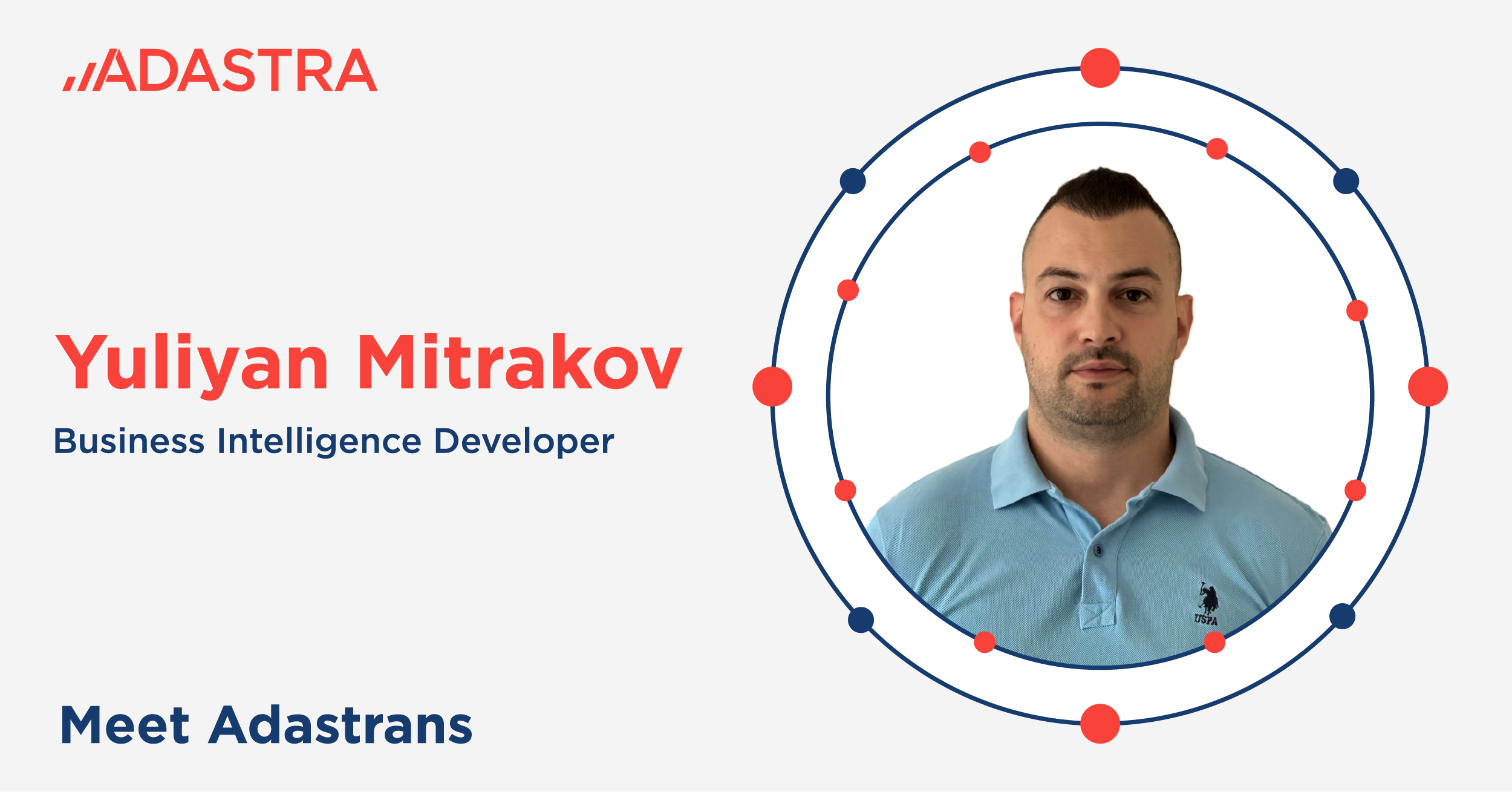
Can you tell us about your background and how you started your career as a Business Intelligence (BI) Developer?
I started as a BI Developer six years ago at a fintech company. This role helped me learn about statistics, data modeling, SQL, and data visualization, which sparked my interest in BI. Seeking further growth, a friend informed me about Adastra and the opportunities the company offered in this field. I am grateful that Adastra recognized my motivation to learn and offered me a position as a BI Developer. This opportunity marked a turning point in my career. Working on interesting projects and alongside experienced teammates has significantly contributed to my growth over the past five years at the company.
What technologies and tools do you use in your work?
Each BI project needs different tools. Typically, this includes a visualization tool (like Power BI), a database (cloud-based or on-premises), and an ETL tool. Lately, I’ve been using the Microsoft stack, including Power BI, SQL Server, and SSAS. Other tools like DAX Studio, Tabular Editor, ALM Toolkit, Visual Studio, and Management Studio help me to work more efficiently.
What are some key projects you have worked on and what challenges did you face?
The most challenging projects I’ve worked on are in manufacturing, especially those needing real-time reporting for production processes. These projects involve complex business logic and custom visualizations. For example, in the automotive sector, I’m working on a project where we process and visualize data from hundreds of robots on an assembly line almost in real-time.
How do you stay current with the latest trends in the BI field?
Staying updated with the latest trends is essential in BI. At Adastra, we have the Power BI Competency Center, which is very helpful. I also subscribe to platforms like Enterprise DNA, SQLBI, and the monthly Power BI updates to keep my skills up to date.
In your opinion, what skills are essential for someone to succeed in a BI role?
To succeed in BI, you need dedication, passion, and a willingness to improve daily. Since the BI role is client-facing, good communication, collaboration, and problem-solving skills are essential. Technically, a strong understanding of data modeling, SQL, and DAX for Power BI is crucial, along with knowledge of Data Warehousing and Data Management.
What are your goals for the next year?
One of my goals is to acquire a diverse skill set, focusing on enhancing my proficiency in both ETL Development and Cloud technologies. Specifically, I aim to acquire skills in Microsoft Fabric to remain competitive and deepen my expertise in this domain. In my role as a Talent Manager, I am also dedicated to enhancing my ability to support my colleagues’ career paths by developing their skills in BI technologies.
Stay tuned for more exciting stories.
Check out the current openings and join a team of top like-minded professionals.