
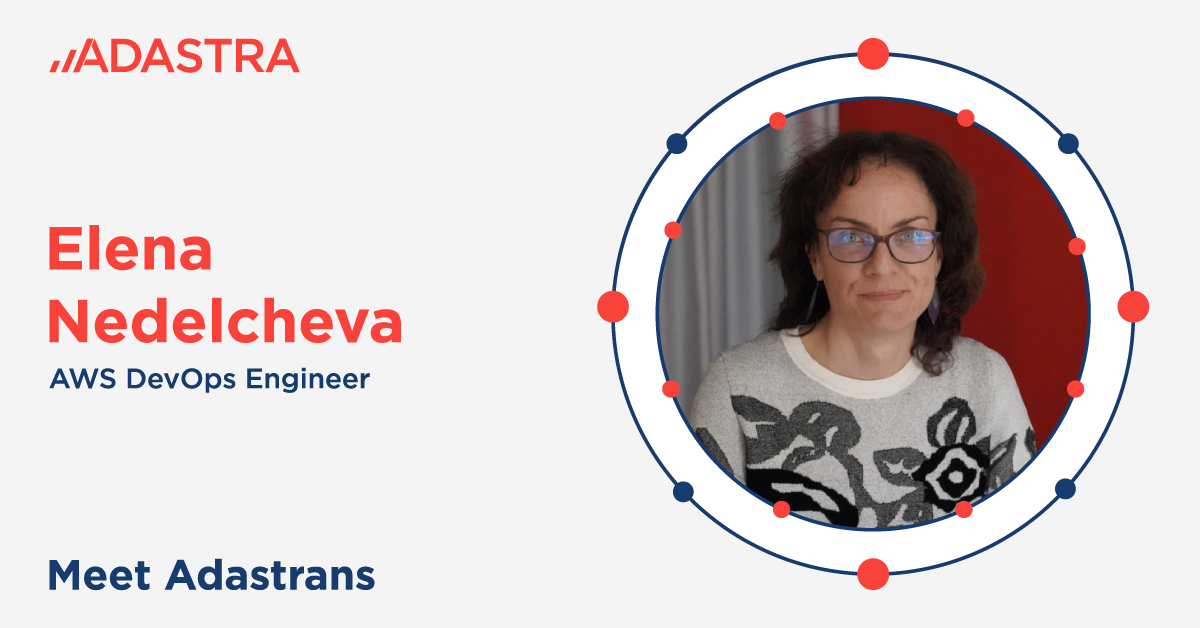
Can you tell us a little about your background and career journey?
I started my journey in the IT world years ago when I decided to study Computer Science and Technology at the Technical University. Since then, I have been deeply involved in the field. As a student, I participated in internships and worked for small companies, which provided invaluable practical experience. These opportunities allowed me to apply theoretical knowledge in real-world scenarios, sharpen my technical skills, and understand the dynamics of working within a team.
When I graduated, I began my career in the corporate IT world. After gaining substantial experience, I decided to transition to a mid-sized company, which led me to my current position. Here, I have been able to leverage my skills and experience to contribute to and grow within the company.
What was your first job in tech, and how did it prepare you for it?
My first job in tech was with a large corporation after graduating from the Technical University. I started on a Level 1 IT team, and over the years, I worked my way up to becoming a technical lead for Level 3 teams, working on projects and architecture.
The interview process for this position was quite rigorous, lasting three full days with the meetings being held in person, in a hotel. It included a variety of technical and language tests, meetings, discussions, and interviews with managerial representatives. By the end of the third day, only ten of us received contract offers.
At the time, my technical knowledge was mostly theoretical, with limited practical experience. However, as I later learned, my soft skills played a significant role in the decision to hire me. This initial job gave me a solid foundation in technical skills and an understanding of the importance of soft skills in achieving career growth and success in the IT industry.
What tools and technologies do you use most frequently in your role?
I have used many different tools and technologies, and it’s hard to say which ones I use most frequently. It depends on the company, task, project objectives, and the design of the environment. One needs to be flexible and a fast learner. Recently, I’ve used tools like Terraform, Python, AWS services, GCP services, Git, Pipelines, and Jira.
Can you describe some of the projects you’ve worked on and what role you played in those projects?
I have worked as an infrastructure engineer in enterprise environments, handling OS, Network, and Storage tasks. I started as an Engineer, later becoming a Team Lead, and was also tasked with architectural decisions. These environments consisted of more than 5 PB of data.
I was also part of projects where I visited data centers for our customers. We inspected, configured, and ran DR tests before entering production mode, as well as testing migrations and HA strategies.
Another significant project involved creating VDI infrastructure as code (IaC) for our end-users. The target environment consisted of more than 5000 VDIs and was implemented using tools for infrastructure deployment, configuration management, continuous integration, pipeline orchestration, container registry, and various operating systems. Tools used included Terraform, Packer, Puppet, Jenkins, Rundeck, Linux, Windows OS, and Bitbucket.
In a cloud context, I was part of a project that provided AWS-configured environments for data-driven teams to use for data analysis. Tools used included Terraform, GitHub, GitHub Pipelines, NewRelic, external tools for file transfer with proprietary protocols, Linux, AWS Networking, VPC, Lambda, Glue jobs, Redshift, and EC2.
In your role, continuous improvement is key. Can you share how you stay updated with industry trends and technologies?
I agree that continuous improvement is essential for my role. There are several ways to stay up-to-date with the industry, including newsletters, training sessions, articles, and participation in focused social groups. Many of these resources are readily available, and some are even free.
Over the years, I have acquired several certifications for various technologies that I have used, such as Brocade, IBM Storages, CompTIA, VMWare, AWS, GCP, and ITIL. These certifications not only validate my expertise but also keep me informed about the latest advancements and best practices in the field.
What advice would you give to someone just starting out in their career in the field?
For someone starting a career as a DevOps or Infrastructure Engineer, my advice would be to understand the basics of IT Infrastructure first and at least one tool from the DevOps categories: build, test, deploy, run, monitoring and logging, metrics, image registries, and automated provisioning. There are many DevOps tools available, and more are being developed. It’s important to understand the underlying concepts rather than trying to master every tool.
Is there anything else you would like to add that we haven’t covered, perhaps a memorable moment or key learning from your experience?
For me personally, the most vivid moments that bring a feeling of accomplishment have to do with the successful conclusion of a project or a task. And of course, the satisfaction and appreciation of our clients.